Note: Not a meme so do not treat as such.
As a kid, I grew up on puzzles. With two older sisters who spent most of their time hanging out with each other, I focused on thousand-piece puzzles until my mom gave in and bought me a Nintendo 64 to occupy myself. And through that, I developed a strong love for games such as Super Mario, and later Pokemon, who not only had fun stories, but beautiful music to accompany. It wasn’t always about the difficulty of the puzzle, or the beauty of the animations. Soundtracks were essential to so many of the games I played; they highlighted stories by escalating during boss battles and resolving during completions of large challenges. Sometimes I would leave my Gameboy on while I was doing homework just to listen to the beautiful music of Pokemon Emerald. Many of these soundtracks became the background for my childhood, and as I grew up, that love of music followed.
One song that has held a special place is from one of my favorite games, Super Mario Galaxy. Catapulting off of the success of Super Mario 64 and Super Mario Sunshine, this game became the 3rd game in the franchise to offer a 3D environment, and what better to do that in, than a game that lets you jump from planet to planet as you alter gravity and experience never-before-seen settings in Mario’s typical 8-world storyline. One of the galaxies in SMG is called Gusty Gardens, which has one of the most famous themes from the entire game, and is my personal favorite. Barring nostalgia, this song written by Mahito Yokota contains such interesting elements that allow the music to pull you further into the world of the story.
Let me try to break down some of those elements, and I invite you to listen along. If you’re not on a laptop, then the audio block may not load for you so you can listen to the song on Youtube here, or an arrangement on Spotify here. Some samples from the sheet music will also be littered throughout this post. Yes, I paid $6 for this music. I meant it when I said it’s one of my favorite songs.
Gusty Gardens opens with a loud fanfare. This fanfare isn’t novel, and many songs in the game do this to accent the discovery of this “new frontier” that SMG has given itself. This is the Mario franchise’s first step into space, but also back into the world of 3D, which was left alone during the games for the Gameboy and DS. Now, it is back and it is making that clear.
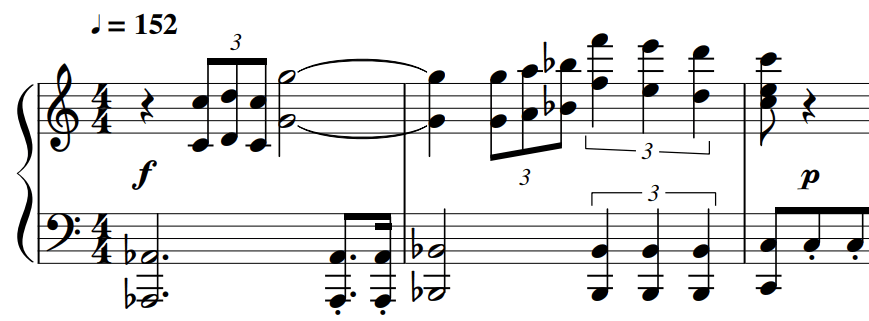
The fanfare ends just as soon as it starts, to make the way for a classical guitar that plays throughout the song. This latin-sounding theme is so fast-paced it’s on the border of feeling rushed, which creates this pull in the music. Almost like the feeling of wind. The melody then starts in the woodwinds, and acts as a simple voice, offering a beginning phrase, or start of a conversation.
One of the things that is incredibly important in a game’s soundtrack is the need to avoid sounding repetitive. You can be repetitive, and you definitely need to circle around to old themes, but the piece needs to feel like it’s going somewhere, so that the player doesn’t feel stuck or bored. And Gusty Gardens keeps the song moving with these conversations in the melody, offering repeated phrases that still sound novel and engaging.
The first few bars of the woodwinds melody introduce what I am going to call a sentence. That sentence, which is about six seconds, is (ignoring the bass line) is:
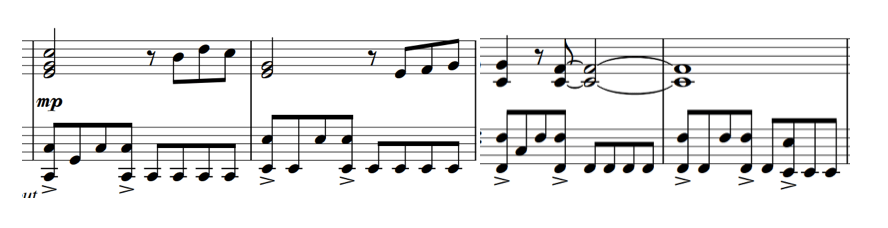
Imagine this sentence being “The weather is really nice today.” The melody then continues with a phrase that sounds incredibly similar, but a little higher and with the ending just a little different, like this:
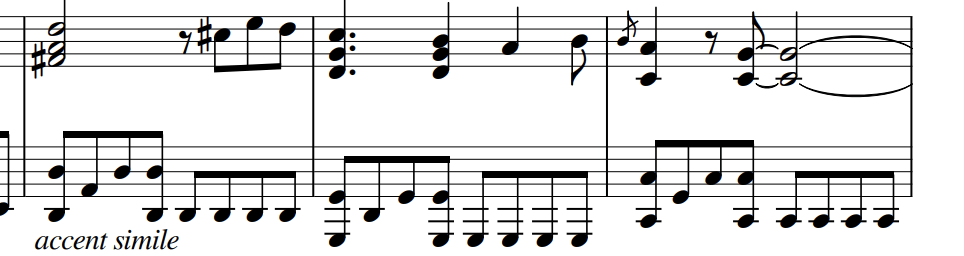
This is the second sentence, which is related to the first but give more information. “The weather is sunny, and it feels warm”.
This ends with two finals phrases, that are half as long as the first two, and offer the most break from the original melody, which give the feel of increasing purpose due to their brevity, and a conclusive fanfare. This is the conclusion to his section. “I feel a wind in the air. There is something out there. Let’s go and see what it is.”
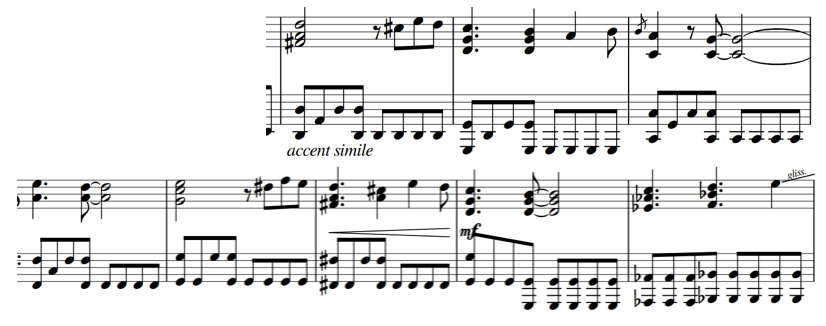
This entire conversation is only about 30 seconds, but is then repeated over again with strings playing a more intense version of it. Then a new conversation starts, and mimics the same style of repetition with novel adjustments. Although they are all very much based off of one another, they are all slightly different and continue to keep the player interested, as the are walking through a planet finding new hidden things in corners and valleys.
Then you get to the peak of the song, at around 1 minute 25 seconds in. It is important to note (hehe) that, most of these conversations have not ended on the starting chords of this song, but rather on slightly higher versions. This offers an air of mystery, but also an air of incompleteness. You don’t have to know anything about music to feel when a resolution hasn’t been created. And with increasing intensity, we jettison to the climax that has short, triumphant phrases that are resolve into our original key, which help give that satisfactory feeling that the entire song teases until now.
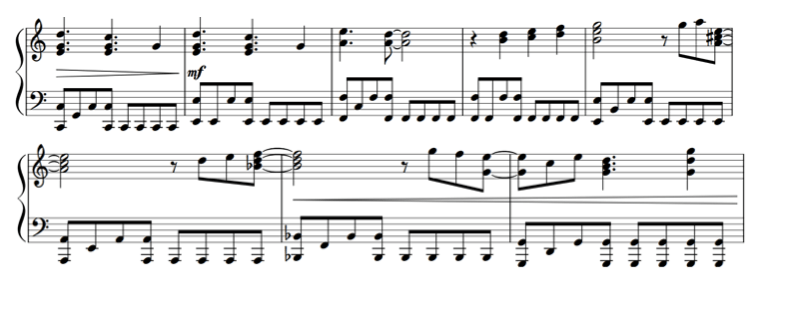
These phrases aren’t too different because you don’t want different at this point in the song, you want common themes and you want a finale, and a return to the original chords with short repetitive phrases does exactly that. This conversation is repeated over again, with the only change being an octave raise at the end of the last phrase (the melody become higher) to give a final hurrah to this story, before the entire song loops over again.
I could continue to go into more reasons that this song is completely entrancing, such as how Yokota plays with the key changes, but I’d rather leave it at what I believe to be a reasonably understandable explanation of some great parts of the song. If you are interested in a deeper analysis, there are a ton of videos online about this exact song. One of my favorite is this Youtube video by 8-bit Music Theory, which is such an amazing channel if you are interested in more video game music analysis.
But I’ll stop there. My goal with this post is to show that even songs without lyrics can tell stories, and pay homage to music that captured my childhood.
 scatterbrain
1 thought on “A Gamer’s Guide to Galaxy’s Gusty Gardens Theme”